


How to Find Your Role in the Revolution

Maybe you’re so burnt out because you’re trying to be everything
Imagine standing over a flower and berating it to become a tree…
It sounds ridiculous, but it’s what so many of us are doing to ourselves and one another within the current leftist movement. Like the flower (and the tree), we each have a unique role to play in the ecosystem of our movement. And like the forest where the tree and flower are planted, we need a diversity of roles.
I used to spend most of my days burning myself out trying to be a flower, and a tree, and a mushroom, and the rain, and the sun…the list could go on. I was in the start-up phase of growing a therapy practice, writing a book, posting free sex ed on social media every day, volunteering and still feeling deeply aware of everything I was not doing. My Instagram followers seemed deeply aware of that too; my comments overflowed with statements like:
“Aren’t you going to post about _______?”
“Do you even care about _______?”
“But what are you doing for _______?”
I didn’t know how it could be possible that I was working harder than I ever had in my life while feeling less effective in our movement than ever before. And then one day, I came across Deepa Iyer’s “Social Change Ecosystem” on Instagram.
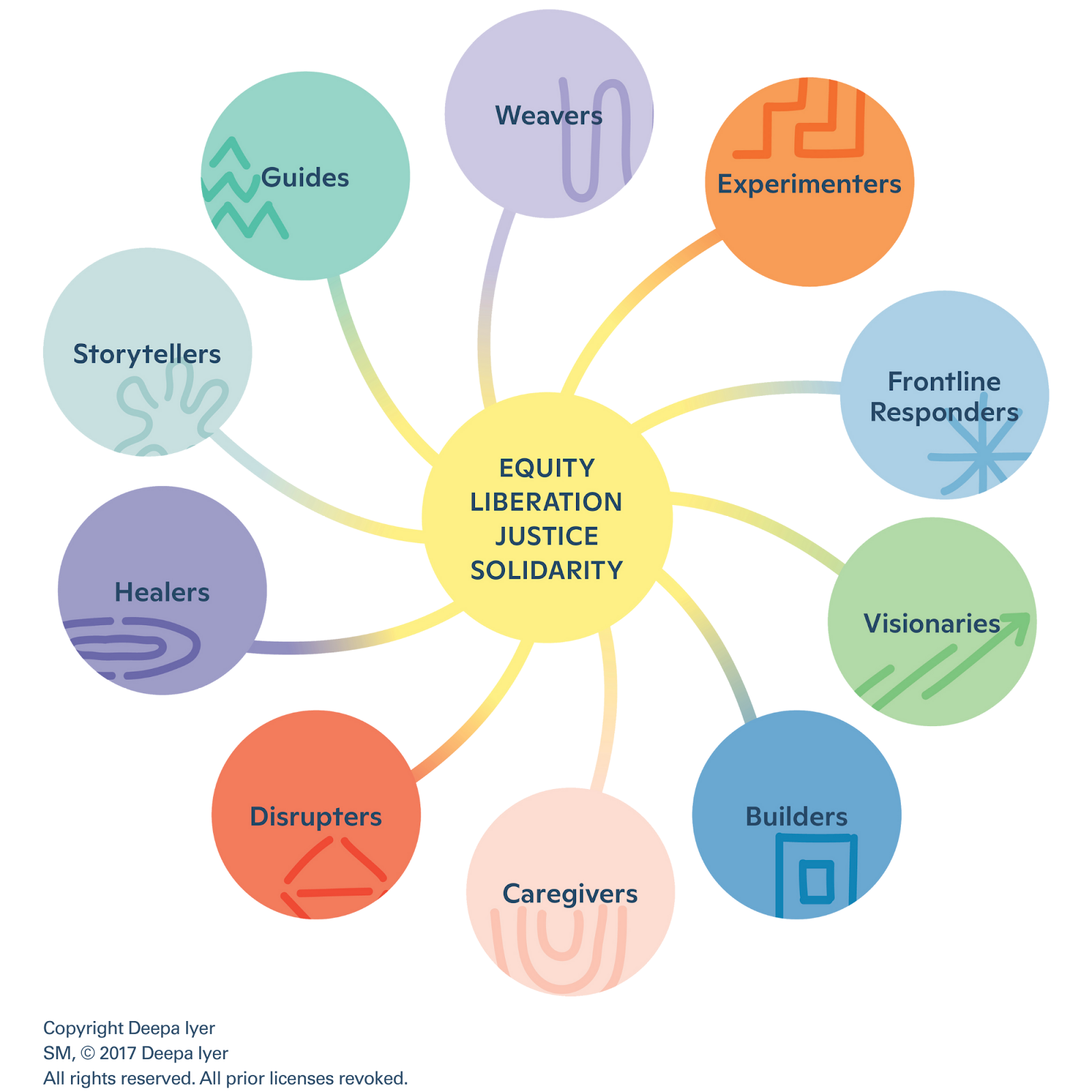
Iyer’s framework offered me a practical resource for clarifying my values and identifying the roles that I was best equipped to play to support my communities. And perhaps even more saliently, it offered permission to stop trying to do it all all the time.
If You’re a Flower, Be a Flower
Centered on the four core values of equity, liberation, justice and solidarity, Iyer’s framework offers 10 roles that we might play (or feel called to play, or aspire to play) as individuals, groups or organizations. The idea here is that if we play one or more of these roles while in relationship with others playing their roles, we build more effective movements.
The United States’ ultra individualistic culture breeds unsustainable activism by convincing us that we must be frontline responders, and visionaries, and builders, and disrupters. It convinces the flower that they should also be a tree, which makes it really hard for the flower to be a really excellent flower.
So what actually allows a flower to be a flower? The presence of biodiversity. The flower is freed up to be a flower because the dirt is nutritious, and the bees are pollinating, and the trees are providing shade. Approached more collectivistically, we have permission to lean into our innate gifts, lived experiences and skills so that we can amplify our contributions within the ecosystem.
The Ten Social Change Roles
Read through the following roles, and notice which ones resonate most with your gifts, experiences and passions. These descriptions are taken directly from Iyer’s workbook, “Social Change Now: A Guide for Reflection and Connection
Frontline Responders: We address community crises by assembling and organizing resources, networks, and messages.
Visionaries: We imagine and generate our boldest possibilities, hopes and dreams, and remind us of our direction.
Builders: We develop, organize, and implement ideas, practices, people, and resources in service to a collective vision.
Disrupters: We take uncomfortable and risky actions to shake up the status quo, to raise awareness, and to build power.
Caregivers: We nurture and nourish the people around us by creating and sustaining a community of care, joy and connection
Experimenters: We innovate, pioneer, and invent. We take risks and course correct as needed.
Weavers: We see the through-lines of connectivity between people, places, organizations, ideas and movements.
Storytellers: We craft and share our community stories, cultures, experiences, histories, and possibilities through art, music, media and movement.
Healers: We recognize and tend to the generational and current traumas caused by oppressive systems, institutions, policies and practies
Guides: We teach, counsel, and advise, using our gifts of well-earned discernment and wisdom.
Time to Reflect:
After reading through the above roles, consider these reflection questions—also taken from Iyer’s incredible workbook:
- What role(s) am I best suited to play, given my skills, innate strengths, lived experiences, knowledge and interests
- Where am I stretched too thin because I am playing multiple roles in multiple contexts?
- How do I sustain my contributions to social change for lasting impact?
- How do I connect with an ecosystem, or organize a new one?
Closing Thoughts
I want to be with you all in this movement for the long-haul. If you’re feeling like you don’t know how much longer you can keep up your current pace, it’s time to pause. I often come back to an African saying that echoes through Bayo Akomolafe’s work:
“The times are urgent; let us slow down.”
The more vital your activism feels, the more important it is that you’re taking the time to build sustainability into that work. We need you to take a breath, and to let yourself be a flower.
Image Credit: Parks and Recreation